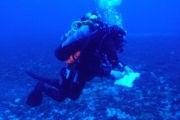
Ray
Boland was born and raised on O'ahu, Hawai'i. In high
school he was part of the Blue-Water Marine Laboratory,
an experiential marine science program, where he learned
the basics of marine science, seamanship and lifesaving
techniques. He attended the University of Hawai'i at
Manoa and was active in the Marine Option Program which
afforded him many practical opportunities in the marine
science field. He was also a student aquarist and worked
in the education department at the Waikiki Aquarium
and as a lab tech at the Hawai'i Institute for Marine
Biology.
In
1990, he participated as a researcher diver on a NOAA
research cruise to the Northwestern Hawaiian Islands,
where he experienced the wilderness of that place. That
cruise became a key point in his life and career. In
1996 Ray received his B.S. in Biology from the University
of Hawai'i and was contracted by the Pacific Islands
Fisheries Science Center, NOAA/NMFS, where he eventually
became a federal research biologist in the Ecosystems
and Oceanography Division.
In
1996, he pioneered studies in marine debris survey and
removal in the Northwestern Hawaiian Islands. His results
and report are the basis for the present day large-scale
marine debris survey and removal effort being conducted
by PIFSC. He also participated in surveys of the Hawaiian
Monk Seal forage base, which led to him being certified
as a trimix diver. He usedf this expewrtise to conduct
studies of the fish assemblages associated with black
coral trees.
As
part of NOAA's Insular Ecosystems Program, Ray's research
interests include reef fish communities, mesophotic
communities and marine debris. Specific projects include
studying the reef fish communities of mesophotic reefs,
black corals and artificial reefs; marine debris survey
and removal; and impacts of catch and release fisheries.
Responsibilities of Unit Dive Supervisor include training
and certification of divers; and overseeing all dive
operations.
His
latest research focuses on the fish communities of mesophotic
reefs, found between the depths of 30 and 150 meters.
Ray has conducted fish surveys ofmesophotic reefs via
SCUBA and submersible in the Main Hawaiian Islands and
the Northwestern Hawaiian Islands and will be utilizing
elements of this dataset for his graduate project.
Ray
successfully defended his thesis on December 5, 2014.

After graduating from HPU, Ray continued working at NOAA's Pacific Islands Fisheries Science Cenmter - Ecosystem and Research Division (ERD) in Honolulu.