Results
We opportunistically necropsied 362 specimens
of 16 species, and documented plastic ingestion in 11
species, belonging to 7 families and 4 orders. Every
sampled Tristram’s Storm-petrel and Bonin petrel
contained plastic, with albatrosses (Laysan, Black-footed)
chicks / adults having high incidence rates (>50%).
We also documented plastic ingestion in wedge-tailed
shearwaters, boobies (red-footed / masked / brown),
red-tailed tropicbirds, greater frigatebirds and brown
noddies. These findings highlight that plastic
pollution is widespread and pervasive in Hawaiian seabirds.
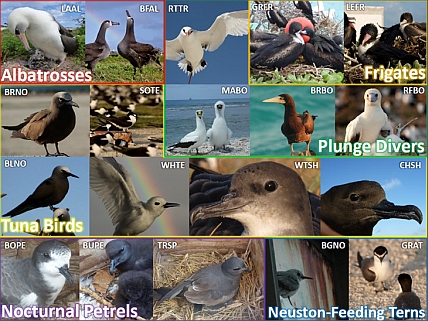
Plastic Incidence: 11 of the 16 species we sampled had ingested plastic. We documented plastic ingestion in five foraging guilds, which were characterized by high levels of species-specific rates: plunge divers (100% of 4 species), albatrosses (100% of 2 species), frigates (100% of 1 species), nocturnal petrels (67% of 3 species), and tuna birds (40% of 5 species). While we did not document plastic ingestion in the neuston feeding tern foraging guild, only one specimen was examined.
Overall, 10 of the 35 species * age groups we sampled had sample sizes large enough to characterize their plastic incidence and loads. These species * age classes showed wide variability in their incidence rates of plastic ingestion, ranging from 0% (Sooty Tern adults / immatures) to 100% (Tristram’s Storm-petrel chicks)
The petrels were characterized by high ingestion rates, for both chicks and adults. In particular five species * age groups had 100% incidence rates: Tristram’s Storm-petrel chicks (60 specimens), Tristram’s Storm-petrel adults (1 specimen), Wedge-tailed Shearwater adults (2 specimens), and Bonin Petrel chicks (5 specimens), and Bonin Petrel adults / immatures (1 specimen).
Conversely, the terns and noddies did not show signs of plastic ingestion, despite the larger sample sizes and multiple age classes sampled: Sooty Terns (14 specimens from three age classes), White Terns (11 specimens from three age classes) and Black Noddies (9 specimens from three age classes). Only 7.1% (1 of 14) of the immature Black Noddies we sampled had ingested plastic.

Plastic Incidence, for species*age groups
where 8 or more birds
were sampled from French Frigate Shoals
between 2006 and 2013.
|
Plastic incidence is reported
as the percentage of birds in each species*age
group with plastic, +/- one S.D. calculated with
binomial probabilities.
The following species are
shown:
- TRSP: Tristram's Storm-petrel
- LAAL: Laysan Albatross
- BFAL: Black-footed Albatross
- GRFR: Greater Frigatebird
- RFBO: Red-footed Booby
- BRNO: Brown Noddy
- SOTE: Sooty Tern
Three age classes are considered:
Chicks, Juveniles and Adults
|
Plastic Incidence Across Foraging
Guilds: To compare plastic prevalence across foraging
guilds, the overall occurrence of plastic ingestion
(from both stomach chambers combined) was calculated
for every species with at least two sampled specimens
(n. 2), by combining the rates across age classes. For
each species, the average occurrence rate was calculated
by averaging across all the sampled age classes.An analysis
of variance (ANOVA) test was used to compare species-specific
prevalence rates across four foraging guilds with two
or more sampled species: albatrosses (2 species), nocturnal-foraging
petrels (3 species), plunge-divers (4 species), and
tuna-birds (5 species). Thus, this analysis involved
322 seabirds, 14 species and 4 guilds.
In addition to comparing these four categorical
groupings, this test considered two co-variates: the
sample size (log of the number of birds sampled per
species) and the proportion of chicks in the sample
(arcsine of the square root of the proportion of chicks
sampled per species).Because sample sizes varied widely
across the 16 species, from 126 (LAAL) to 2 (BUPE, MABO),
this potential bias was considered in the analysis.
Additionally, because the proportion of chicks sampled
varied from species to species, from 0% (BRBO, BUPE)
to 98.3% (TRSP), this factor was considered to address
age-specific disparities in plastic ingestion rates.
To ensure normality, the occurrence data were arcsine
transformed (yf = arcsin (y)1/2), prior to performing
the ANOVA.
The comparison of the species-specific
occurrence rates did not reveal significant differences
across foraging guilds, (F3,8= 1.088; p =0.408), and
no bias due to the varying sample sizes (F1,8= 0.166;
p =0.694). Yet, the proportion of chicks/juveniles in
the sample did have a significant influence on the plastic
occurrence rate (F3,8 =6.146; p = 0.038). Finally, the
ANOVA residuals were normally distributed (One-sample
Kolmogorov-Smirnov test, n= 14, max_diff = 0.198, p
= 0.574).
A follow-up linear regression
confirmed that species-specific occurrence rates increased
significantly (F1,12 = 15.410; p = 0.002), with a higher
proportion of chicks/juveniles in the sample (slope
coefficient = 1.021 ± 0.260 S.E.). This model
accounted for 56.2% of the observed variance, and the
regression residuals were normally distributed (One-sample
Kolmogorov-Smirnov test, n= 14, max_diff = 0.143, p
=0.899).
|
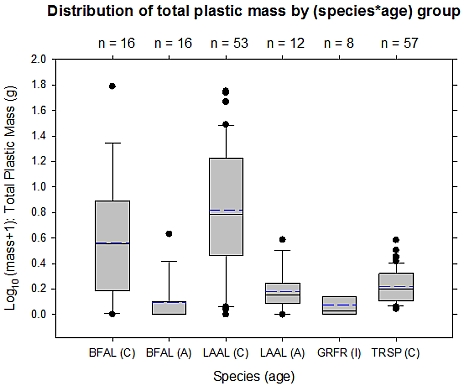
Plastic mass, for
species * age groups with large enough sample
sizes (where ≥ 8 birds sampled).
To achieve normality,
the mass values are Log10 (X+1) transformed.
The box plots show
the distribution quartiles (25th, 50th,
75th %), the whiskers show the range (10th,
90th %), and the circles highlight outliers.
Note that the mean
is depicted by the blue dashed line.
|
Total Plastic Mass: When
we compared the ingested plastic mass was across species
* age groups, albatrosses had the largest loads, with
maximums of 60.3305 g (Black-footed chick) and 55.4142
g (Laysan chick). Yet, adult albatrosses had substantially
lower plastic loads, with maximums of 3.2639 g (Black-footed)
and 2.8551 g (Laysan). Nevertheless, we observed
highly-skewed distributions of plastic loads in all
of the species * groups that were examined. The large
S.D.s and outliers suggest there is a high degree of
individual variability in the plastic masses ingested
by chicks and adults.
Plastic Mass by Organ:
Contingency G tests comparing the incidence (presence
/ absence) of ingested plastic in the two stomach chambers
of petrel species revealed significant differences between
the proventriculus and the gizzard for the two albatrosses.
NOTE: Tristram's Storm-petrels had 100% incidence in
the proventricculus and the gizzard.
|
Species
|
Age
|
Fisher's
Exact Test
|
Result
|
|
BFAL
|
Chicks
|
0.2258
|
Not significant (Pro > Vert)
|
|
BFAL
|
Adults
|
0.5765
|
Not significant (Pro > Vert)
|
|
LAAL
|
Chicks
|
1.0000
|
Not significant (Pro =Vert)
|
|
LAAL
|
Adults
|
0.5865
|
Not significant (Pro < Vert)
|
|
TRSP
|
Chicks
|
1.0000
|
Not significant (Pro =Vert)
|
These patterns suggest that
these seabirds are retaining ingested plastic in both
the ventriculus and the proventriculus. This is especially
apparent in chicks, which are characterized by equal
incidence rates in both stomach organs. In the case
of the Black-footed Albatross, both chicks and adults
had higher plastic incidence in the proventriculus.
We hypothesize that the line and foam ingested by this
species may have a difficult time passing into the gizzard
leading to its retention in the proventriculus. Comverselly,
adult Laysan Albatross had higher plastic incidence
in the ventriculues, suggesting thatthe fragments ingested
by this species can pass through the proventriculus
more easily.
 |
Examples of the plastic items ingested by seabirds, highlighting the variety of fragment colors / sizes.
The panels illustrate the size spectrum of ingested items, ranging from < 1 mm in the Tristram Storm-petrel (A) to a few cm in the Laysan Albatross (B). Note the 10 mm grid scale, used for reference
|
Conclusions
These results underscored a series of research gaps, relating to the incidence / loads of plastic ingestion in specific species * age class groups. Thus, these research gaps highlight 4 priorities: unstudied species, poorly-studied species with documented plastic ingestion, poorly-studied species without documented ingestion, and species with high plastic ingestion rates. Ideally, sample sizes of 8 - 20 specimens per age * species are needed to develop robust incidence rates, with small confidence intervals. Additional samples (20 - 50) are required to quantify plastic loads by species * age class, especially given the low incidence rates and the non-normal distributions of the ingested plastic mass |